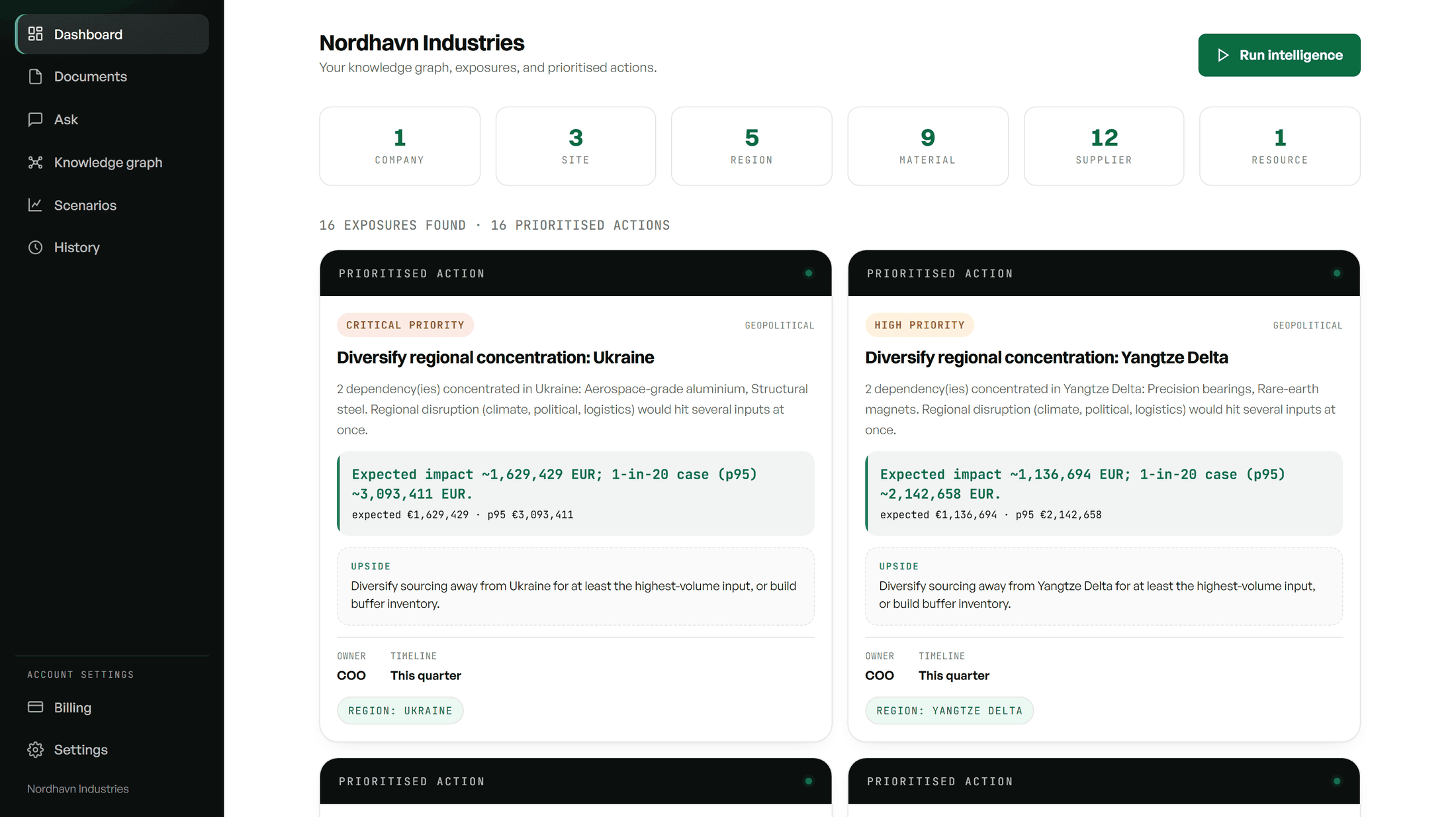
Documents in. A private knowledge graph. Deterministic reasoning. Seeded simulation. A ranked set of decisions out. You can inspect each step.
Sustainability reports, supplier master lists, site data, energy and emissions records, audits. PDF, XLSX or CSV.
A private knowledge graph, authored rules that find exposures, and seeded Monte Carlo that prices each one.
Ranked actions with expected impact, a p95 downside, an owner, a timeline and the evidence behind each.
Sustain turns messy documents into structured, provenanced facts. Each extracted value keeps its unit, its reporting year, the document and page it came from, and a confidence score. The validator quarantines what it cannot accept for review, instead of guessing.
Extracted values · choose one
Provenance
Your company as a network of sites, suppliers, materials, products and regions. This is not a visualisation bolted on afterwards. It is the structure the reasoning engine traverses, which is why concentration and single-source risk become visible at all.
Material
RE-7
Connections (2)
Exposures
Single-source dependency on a 14-week lead time input. Rule SS-02 v4 · €820,400 expected · €1,410,000 at p95
A grounded assistant that knows both your data and the product. Ask what a figure means, how to get data in, or what your own documents say. It answers from your uploaded files, a regulatory corpus and Sustain's own guidance, and it cites what it used. Sustain lets a language model speak here and nowhere else, and it still produces no number.
Authored rules find exposures in the graph. Sustain then prices each exposure on its own with a seeded Monte Carlo run, producing an expected impact and a p95 downside rather than a single optimistic guess.
Distribution of outcomes
10,000 simulations · v2026.08.1 · seed 4471982003
95th percentile
€1,410,000
The p95 downside: one year in twenty is at least this bad.
Illustrative figures from a representative dataset. Not a customer result.
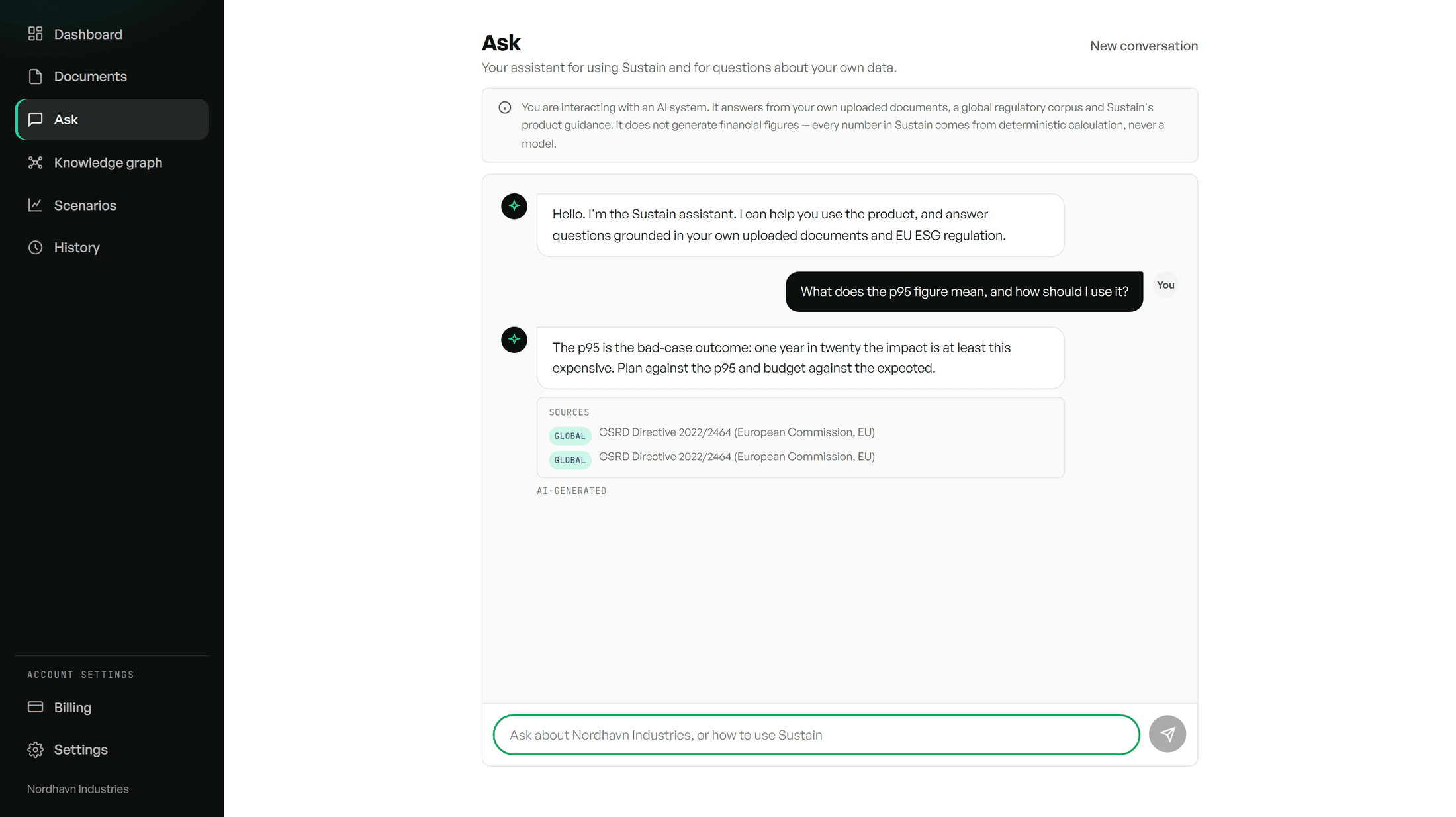
Ask what a disruption would cost before it happens. A supplier halt, a region becoming unavailable, an input price shock. Thousands of simulations return a range, and a ranked set of mitigations with the residual risk for each.
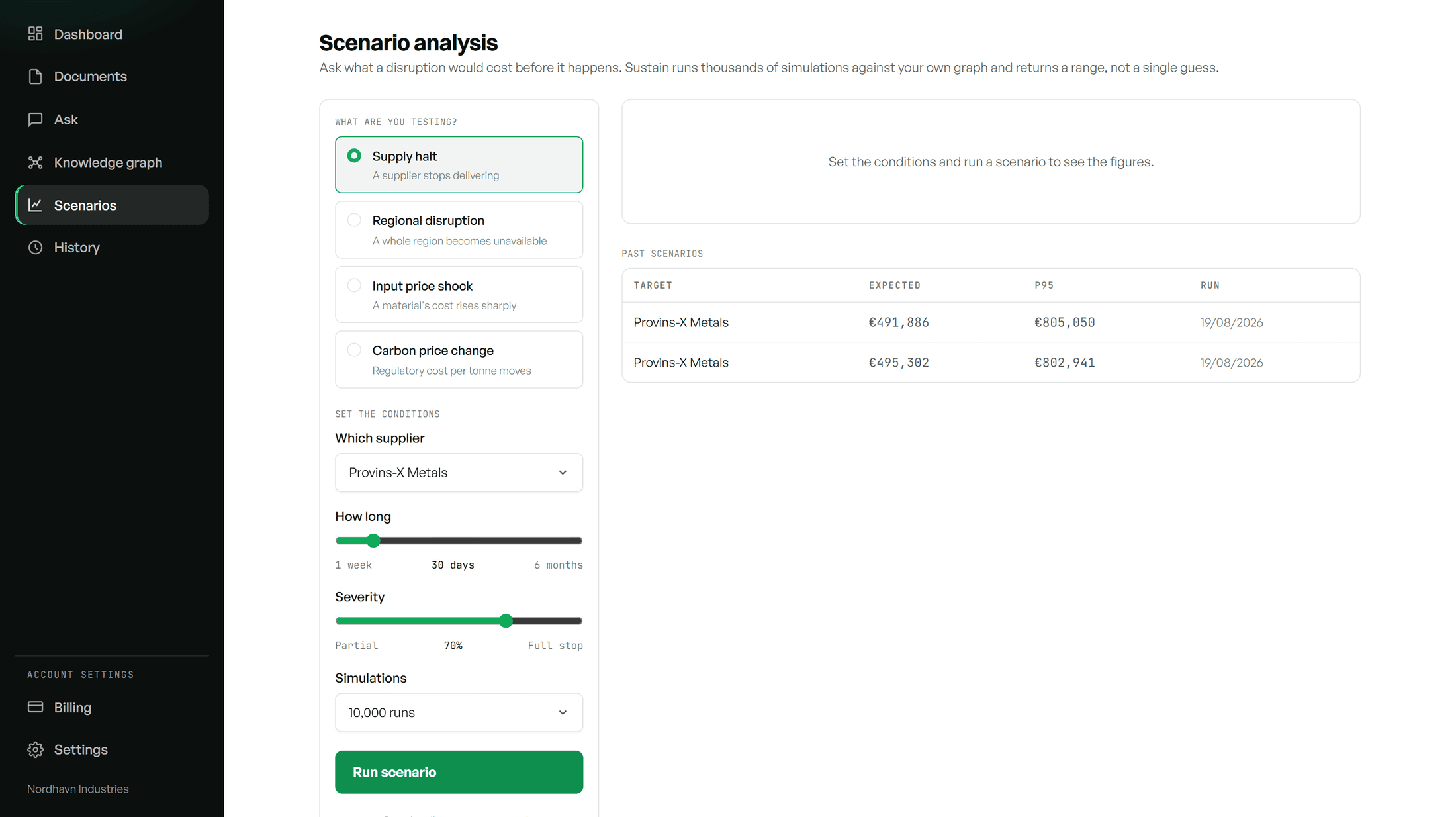
Sustain remembers what it recommended, whether you acted, and what happened. Over time your own results sharpen the next recommendation, and you can see where an estimate diverged from reality.
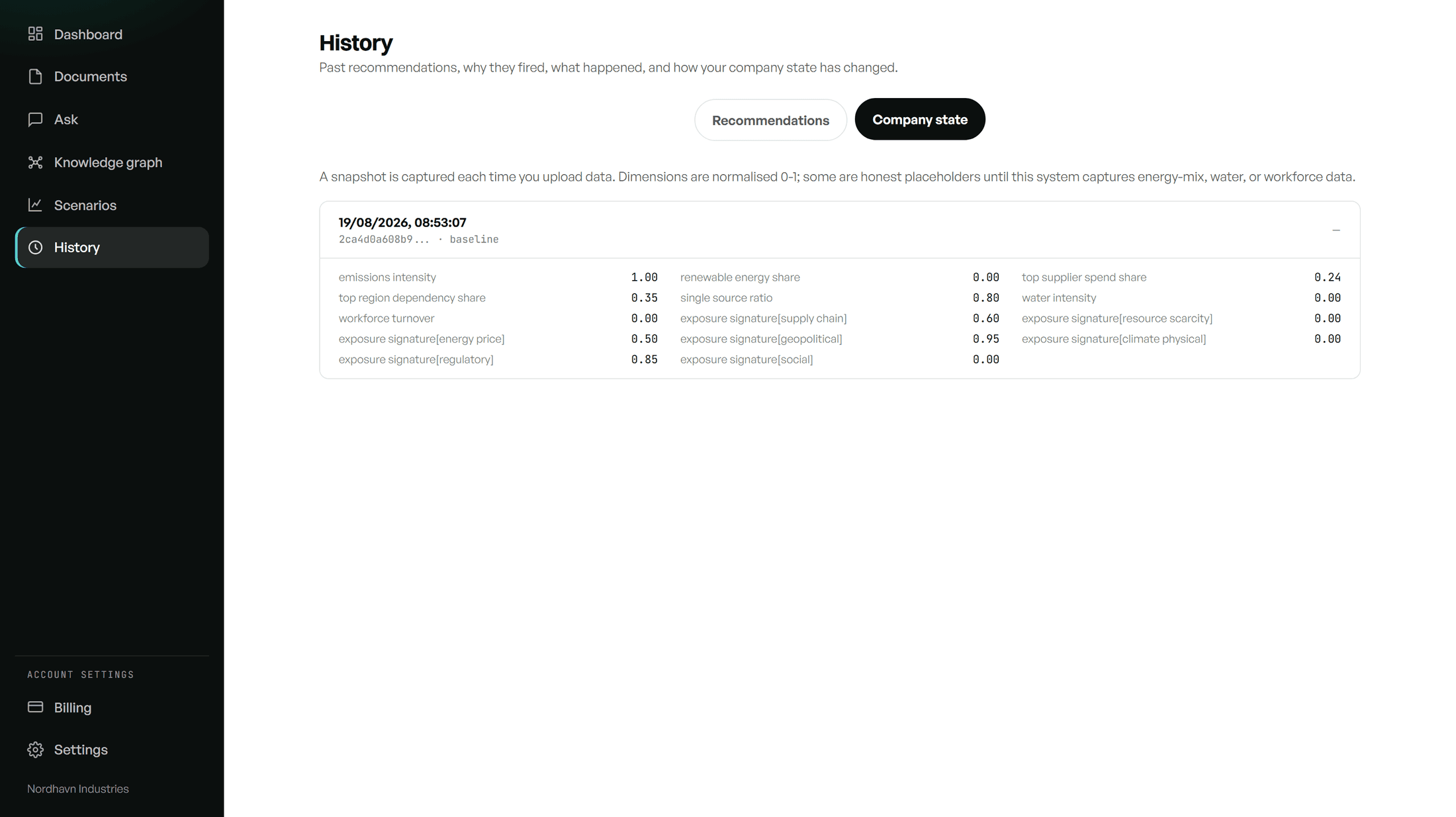
Boards decide on these figures, so each one opens all the way down to the document it came from.
A language model that is right today can change its answer tomorrow. That is not good enough when the output is a figure a board will act on. So Sustain's reasoning, simulation and ranking are deterministic code, not a prompt.
Sustain uses AI in two places: turning a messy document into structured data, and writing the plain-language explanation around figures it has already calculated.
Turn the language model off and each number stays identical. We enforce that with a test that runs on every release.
It produces the analysis, the figures and the evidence. Management decides. That boundary is deliberate, and it is not going to move.
Sustain is in its project phase. We would rather tell you where it stands than imply more.
The demo uses your data, not ours.